NAME
Minion - Job queue
SYNOPSIS
use Minion;

# Connect to backend
my $minion = Minion->new(Pg => 'postgresql://postgres@/test');

# Add tasks
$minion->add_task(something_slow => sub ($job, @args) {
  sleep 5;
  say 'This is a background worker process.';
});

# Enqueue jobs
$minion->enqueue(something_slow => ['foo', 'bar']);
$minion->enqueue(something_slow => [1, 2, 3] => {priority => 5});

# Perform jobs for testing
$minion->enqueue(something_slow => ['foo', 'bar']);
$minion->perform_jobs;

# Start a worker to perform up to 12 jobs concurrently
my $worker = $minion->worker;
$worker->status->{jobs} = 12;
$worker->run;
DESCRIPTION
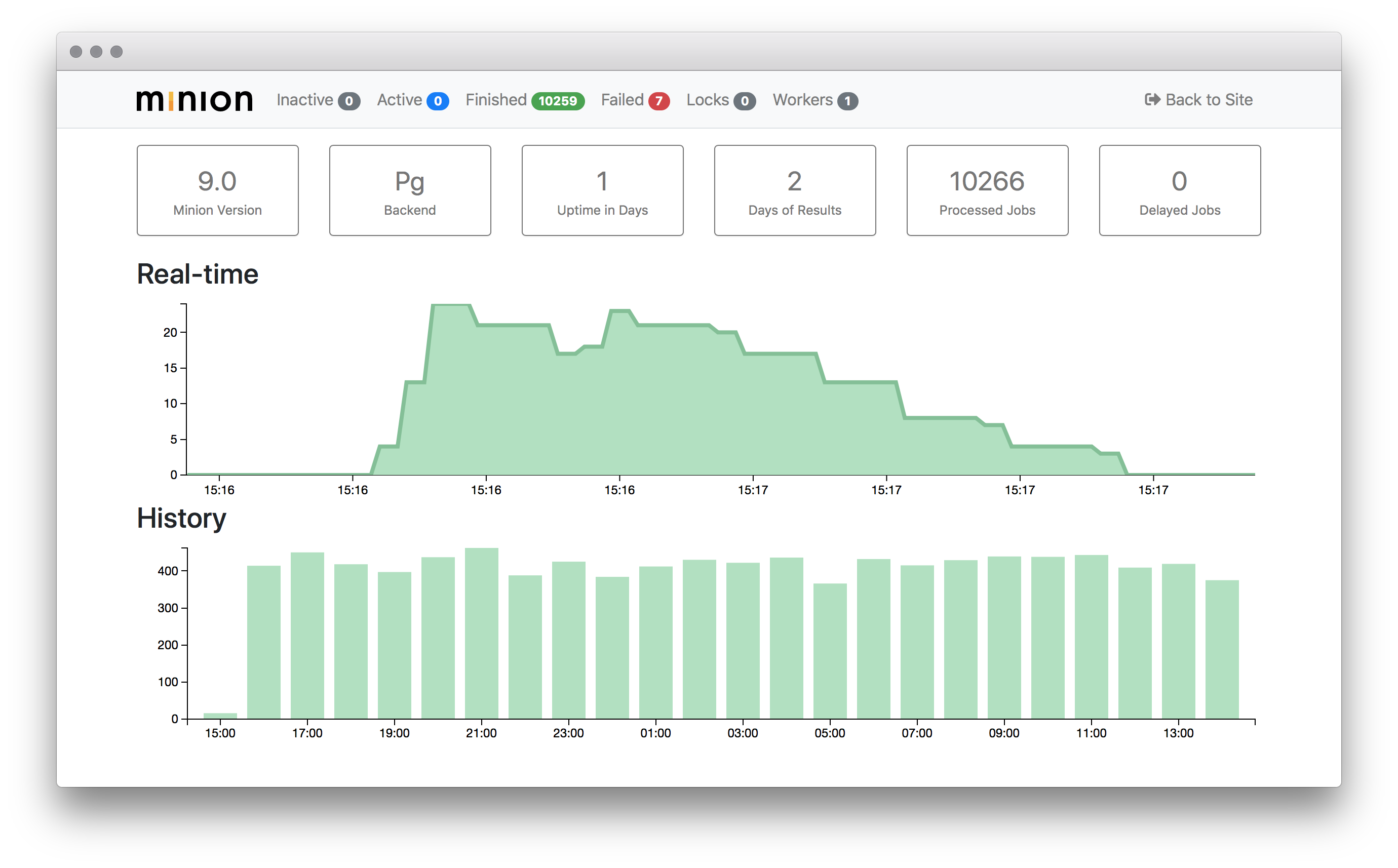
Minion is a high performance job queue for the Perl programming language, with support for multiple named queues, priorities, high priority fast lane, delayed jobs, cron style recurring jobs, job dependencies, job progress, job results, retries with backoff, rate limiting, unique jobs, expiring jobs, statistics, distributed workers, parallel processing, autoscaling, remote control, Mojolicious admin ui, resource leak protection and multiple backends (such as PostgreSQL).
Job queues allow you to process time and/or computationally intensive tasks in background processes, outside of the request/response lifecycle of web applications. Among those tasks you'll commonly find image resizing, spam filtering, HTTP downloads, building tarballs, warming caches and basically everything else you can imagine that's not super fast.
Take a look at our excellent documentation in Minion::Guide!
EXAMPLES
This distribution also contains a great example application you can use for inspiration. The link checker will show you how to integrate background jobs into well-structured Mojolicious applications.
EVENTS
Minion inherits all events from Mojo::EventEmitter and can emit the following new ones.
enqueue
$minion->on(enqueue => sub ($minion, $id) {
  ...
});
Emitted after a job has been enqueued, in the process that enqueued it.
$minion->on(enqueue => sub ($minion, $id) {
  say "Job $id has been enqueued.";
});
enqueue_from_schedule
$minion->on(enqueue_from_schedule => sub ($minion, $id, $name) {
  ...
});
Emitted for every job that "dispatch_schedules" has just enqueued, in the process that called it. The $name argument is the schedule name. The "enqueue" event is also emitted for each of these jobs.
$minion->on(enqueue_from_schedule => sub ($minion, $id, $name) {
  say qq{Schedule "$name" enqueued job $id.};
});
worker
$minion->on(worker => sub ($minion, $worker) {
  ...
});
Emitted in the worker process after it has been created.
$minion->on(worker => sub ($minion, $worker) {
  say "Worker $$ started.";
});
ATTRIBUTES
Minion implements the following attributes.
app
my $app = $minion->app;
$minion = $minion->app(MyApp->new);
Application for job queue, defaults to a Mojo::HelloWorld object. Note that this attribute is weakened.
backend
my $backend = $minion->backend;
$minion     = $minion->backend(Minion::Backend::Pg->new);
Backend, usually a Minion::Backend::Pg object.
backoff
my $cb  = $minion->backoff;
$minion = $minion->backoff(sub {...});
A callback used to calculate the delay for automatically retried jobs, defaults to (retries ** 4) + 15 (15, 16, 31, 96, 271, 640...), which means that roughly 25 attempts can be made in 21 days.
$minion->backoff(sub ($retries) {
  return ($retries ** 4) + 15 + int(rand 30);
});
missing_after
my $after = $minion->missing_after;
$minion   = $minion->missing_after(172800);
Amount of time in seconds after which workers without a heartbeat will be considered missing and removed from the registry by "repair", defaults to 1800 (30 minutes).
remove_after
my $after = $minion->remove_after;
$minion   = $minion->remove_after(86400);
Amount of time in seconds after which jobs that have reached the state finished and have no unresolved dependencies will be removed automatically by "repair", defaults to 172800 (2 days). It is not recommended to set this value below 2 days.
stuck_after
my $after = $minion->stuck_after;
$minion   = $minion->stuck_after(86400);
Amount of time in seconds after which jobs that have not been processed will be considered stuck by "repair" and transition to the failed state, defaults to 172800 (2 days).
tasks
my $tasks = $minion->tasks;
$minion   = $minion->tasks({foo => sub {...}});
Registered tasks.
METHODS
Minion inherits all methods from Mojo::EventEmitter and implements the following new ones.
add_task
$minion = $minion->add_task(foo => sub {...});
$minion = $minion->add_task(foo => 'MyApp::Task::Foo');
Register a task, which can be a closure or a custom Minion::Job subclass. Note that support for custom task classes is EXPERIMENTAL and might change without warning!
# Job with result
$minion->add_task(add => sub ($job, $first, $second) {
  $job->finish($first + $second);
});
my $id = $minion->enqueue(add => [1, 1]);
my $result = $minion->job($id)->info->{result};
broadcast
my $bool = $minion->broadcast('some_command');
my $bool = $minion->broadcast('some_command', [@args]);
my $bool = $minion->broadcast('some_command', [@args], [$id1, $id2, $id3]);
Broadcast remote control command to one or more workers.
# Broadcast "stop" command to all workers to kill job 10025
$minion->broadcast('stop', [10025]);

# Broadcast "kill" command to all workers to interrupt job 10026
$minion->broadcast('kill', ['INT', 10026]);

# Broadcast "jobs" command to pause worker 23
$minion->broadcast('jobs', [0], [23]);

# Broadcast "spare" command to disable the feature on all workers
$minion->broadcast('spare', [0]);
class_for_task
my $class = $minion->class_for_task('foo');Return job class for task. Note that this method is EXPERIMENTAL and might change without warning!
dispatch_schedules
my $dispatched = $minion->dispatch_schedules;Enqueue jobs for all schedules whose firing time has been reached, advance their firing times to the next match, and return information about each dispatch as an array reference. Coordinates across multiple workers via a Postgres advisory lock so a single tick never enqueues a schedule twice. Workers tick this automatically, see Minion::Worker.
# Manually fire any due schedules
for my $info (@{$minion->dispatch_schedules}) {
  say qq{Schedule "$info->{name}" enqueued job $info->{job}.};
}
enqueue
my $id = $minion->enqueue('foo');
my $id = $minion->enqueue(foo => [@args]);
my $id = $minion->enqueue(foo => [@args] => {priority => 1});
Enqueue a new job with inactive state. Arguments get serialized by the "backend" (often with Mojo::JSON), so you shouldn't send objects and be careful with binary data, nested data structures with hash and array references are fine though.
These options are currently available:
- attempts
-
attempts => 25Number of times performing this job will be attempted, with a delay based on "backoff" after the first attempt, defaults to
1. - delay
-
delay => 10Delay job for this many seconds (from now), defaults to
0. - expire
-
expire => 300Job is valid for this many seconds (from now) before it expires.
- lax
-
lax => 1Existing jobs this job depends on may also have transitioned to the
failedstate to allow for it to be processed, defaults tofalse. - notes
-
notes => {foo => 'bar', baz => [1, 2, 3]}Hash reference with arbitrary metadata for this job that gets serialized by the "backend" (often with Mojo::JSON), so you shouldn't send objects and be careful with binary data, nested data structures with hash and array references are fine though.
- parents
-
parents => [$id1, $id2, $id3]One or more existing jobs this job depends on, and that need to have transitioned to the state
finishedbefore it can be processed. - priority
-
priority => 5Job priority, defaults to
0. Jobs with a higher priority get performed first. Priorities can be positive or negative, but should be in the range between100and-100. - queue
-
queue => 'important'Queue to put job in, defaults to
default.
foreground
my $bool = $minion->foreground($id);Retry job in minion_foreground queue, then perform it right away with a temporary worker in this process, very useful for debugging.
guard
my $guard = $minion->guard('foo', 3600);
my $guard = $minion->guard('foo', 3600, {limit => 20});
Same as "lock", but returns a scope guard object that automatically releases the lock as soon as the object is destroyed, or undef if aquiring the lock failed.
# Only one job should run at a time (unique job)
$minion->add_task(do_unique_stuff => sub ($job, @args) {
  return $job->finish('Previous job is still active')
    unless my $guard = $minion->guard('fragile_backend_service', 7200);
  ...
});

# Only five jobs should run at a time and we try again later if necessary
$minion->add_task(do_concurrent_stuff => sub ($job, @args) {
  return $job->retry({delay => 30})
    unless my $guard = $minion->guard('some_web_service', 60, {limit => 5});
  ...
});
history
my $history = $minion->history;Get history information for job queue.
These fields are currently available:
- daily
-
daily => [{epoch => 12345, finished_jobs => 95, failed_jobs => 2}, ...]Hourly counts for processed jobs from the past day.
is_locked
my $bool = $minion->is_locked('foo');Check if a lock with that name is currently active.
job
my $job = $minion->job($id);Get Minion::Job object without making any changes to the actual job or return undef if job does not exist.
# Check job state
my $state = $minion->job($id)->info->{state};

# Get job metadata
my $progress = $minion->job($id)->info->{notes}{progress};

# Get job result
my $result = $minion->job($id)->info->{result};
jobs
my $jobs = $minion->jobs;
my $jobs = $minion->jobs({states => ['inactive']});
Return Minion::Iterator object to safely iterate through job information.
# Iterate through jobs for two tasks
my $jobs = $minion->jobs({tasks => ['foo', 'bar']});
while (my $info = $jobs->next) {
  say "$info->{id}: $info->{state}";
}

# Remove all failed jobs from a named queue
my $jobs = $minion->jobs({states => ['failed'], queues => ['unimportant']});
while (my $info = $jobs->next) {
  $minion->job($info->{id})->remove;
}

# Count failed jobs for a task
say $minion->jobs({states => ['failed'], tasks => ['foo']})->total;
These options are currently available:
- ids
-
ids => ['23', '24']List only jobs with these ids.
- notes
-
notes => ['foo', 'bar']List only jobs with one of these notes.
- queues
-
queues => ['important', 'unimportant']List only jobs in these queues.
- states
-
states => ['inactive', 'active']List only jobs in these states.
- tasks
-
tasks => ['foo', 'bar']List only jobs for these tasks.
These fields are currently available:
- args
-
args => ['foo', 'bar']Job arguments.
- attempts
-
attempts => 25Number of times performing this job will be attempted.
- children
-
children => ['10026', '10027', '10028']Jobs depending on this job.
- created
-
created => 784111777Epoch time job was created.
- delayed
-
delayed => 784111777Epoch time job was delayed to.
- expires
-
expires => 784111777Epoch time job is valid until before it expires.
- finished
-
finished => 784111777Epoch time job was finished.
- id
-
id => 10025Job id.
- lax
-
lax => 0Existing jobs this job depends on may also have failed to allow for it to be processed.
- notes
-
notes => {foo => 'bar', baz => [1, 2, 3]}Hash reference with arbitrary metadata for this job.
- parents
-
parents => ['10023', '10024', '10025']Jobs this job depends on.
- priority
-
priority => 3Job priority.
- queue
-
queue => 'important'Queue name.
- result
-
result => 'All went well!'Job result.
- retried
-
retried => 784111777Epoch time job has been retried.
- retries
-
retries => 3Number of times job has been retried.
- started
-
started => 784111777Epoch time job was started.
- state
-
state => 'inactive'Current job state, usually
active,failed,finishedorinactive. - task
-
task => 'foo'Task name.
- time
-
time => 78411177Server time.
- worker
-
worker => '154'Id of worker that is processing the job.
list_schedules
my $results = $minion->list_schedules(0, 10);
my $results = $minion->list_schedules(0, 10, {names => ['daily']});
Return information about schedules in batches.
# Get the total number of schedules
my $num = $minion->list_schedules(0, 100)->{total};

# Inspect the next firing time of a schedule by name
my $next = $minion->list_schedules(0, 1, {names => ['daily']})->{schedules}[0]{next_run};
These options are currently available:
- before
-
before => 23List only schedules before this id.
- ids
-
ids => ['23', '24']List only schedules with these ids.
- names
-
names => ['foo', 'bar']List only schedules with these names.
These fields are currently available:
- args
-
args => ['foo', 'bar']Job arguments.
- attempts
-
attempts => 25Number of attempts each enqueued job will get.
- created
-
created => 784111777Epoch time the schedule was created.
- cron
-
cron => '0 9 * * 1-5'Cron expression.
- expire
-
expire => 300Expiration in seconds for each enqueued job.
- id
-
id => 23Schedule id.
- last_job
-
last_job => '10025'Id of the most recently enqueued job, or
undefif the schedule has not fired yet. - last_run
-
last_run => 784111777Epoch time the schedule last fired, or
undefif it has not fired yet. - lax
-
lax => 0Lax dependency setting for each enqueued job.
- name
-
name => 'daily'Schedule name.
- next_run
-
next_run => 784111777Epoch time the schedule will fire next.
- notes
-
notes => {foo => 'bar'}Hash reference with arbitrary metadata applied to each enqueued job.
- paused
-
paused => 0True if the schedule is paused and will not fire.
- priority
-
priority => 0Priority of each enqueued job.
- queue
-
queue => 'default'Queue each enqueued job is placed in.
- task
-
task => 'foo'Task name.
lock
my $bool = $minion->lock('foo', 3600);
my $bool = $minion->lock('foo', 3600, {limit => 20});
Try to acquire a named lock that will expire automatically after the given amount of time in seconds. You can release the lock manually with "unlock" to limit concurrency, or let it expire for rate limiting. For convenience you can also use "guard" to release the lock automatically, even if the job failed.
# Only one job should run at a time (unique job)
$minion->add_task(do_unique_stuff => sub ($job, @args) {
  return $job->finish('Previous job is still active')
    unless $minion->lock('fragile_backend_service', 7200);
  ...
  $minion->unlock('fragile_backend_service');
});

# Only five jobs should run at a time and we wait for our turn
$minion->add_task(do_concurrent_stuff => sub ($job, @args) {
  sleep 1 until $minion->lock('some_web_service', 60, {limit => 5});
  ...
  $minion->unlock('some_web_service');
});

# Only a hundred jobs should run per hour and we try again later if necessary
$minion->add_task(do_rate_limited_stuff => sub ($job, @args) {
  return $job->retry({delay => 3600})
    unless $minion->lock('another_web_service', 3600, {limit => 100});
  ...
});
An expiration time of 0 can be used to check if a named lock could have been acquired without creating one.
# Check if the lock "foo" could have been acquired
say 'Lock could have been acquired' unless $minion->lock('foo', 0);
Or to simply check if a named lock already exists you can also use "is_locked".
These options are currently available:
- limit
-
limit => 20Number of shared locks with the same name that can be active at the same time, defaults to
1.
new
my $minion = Minion->new(Pg => 'postgresql://postgres@/test');
my $minion = Minion->new(Pg => Mojo::Pg->new);
Construct a new Minion object.
pause_schedule
my $bool = $minion->pause_schedule('daily');Pause a schedule by name so it stops firing until resumed. Returns true on success, false if the schedule does not exist.
perform_jobs
$minion->perform_jobs;
$minion->perform_jobs({queues => ['important']});
Perform all jobs with a temporary worker, very useful for testing.
# Longer version
my $worker = $minion->worker;
while (my $job = $worker->register->dequeue(0)) { $job->perform }
$worker->unregister;
These options are currently available:
- id
-
id => '10023'Dequeue a specific job.
- min_priority
-
min_priority => 3Do not dequeue jobs with a lower priority.
- queues
-
queues => ['important']One or more queues to dequeue jobs from, defaults to
default.
perform_jobs_in_foreground
$minion->perform_jobs_in_foreground;
$minion->perform_jobs_in_foreground({queues => ['important']});
Same as "perform_jobs", but all jobs are performed in the current process, without spawning new processes.
repair
$minion = $minion->repair;Repair worker registry and job queue if necessary.
reset
$minion = $minion->reset({all => 1});Reset job queue.
These options are currently available:
- all
-
all => 1Reset everything.
- locks
-
locks => 1Reset only locks.
result_p
my $promise = $minion->result_p($id);
my $promise = $minion->result_p($id, {interval => 5});
Return a Mojo::Promise object for the result of a job. The state finished will result in the promise being fullfilled, and the state failed in the promise being rejected. This operation can be cancelled by resolving the promise manually at any time.
# Enqueue job and receive the result at some point in the future
my $id = $minion->enqueue('foo');
$minion->result_p($id)->then(sub ($info) {
  my $result = ref $info ? $info->{result} : 'Job already removed';
  say "Finished: $result";
})->catch(sub ($info) {
  say "Failed: $info->{result}";
})->wait;
These options are currently available:
- interval
-
interval => 5Polling interval in seconds for checking if the state of the job has changed, defaults to
3.
resume_schedule
my $bool = $minion->resume_schedule('daily');Resume a previously paused schedule. Returns true on success, false if the schedule does not exist.
schedule
my $id = $minion->schedule('daily', '0 4 * * *', 'cleanup');
my $id = $minion->schedule('daily', '0 4 * * *', 'cleanup', [@args]);
my $id = $minion->schedule(
  'daily', '0 4 * * *', 'cleanup', [@args], {priority => 5});
Create or update a schedule by unique name. The cron expression is parsed up front, so invalid expressions raise an exception immediately. The expression uses the standard five field form (minute, hour, day-of-month, month, day-of-week), with *, */N, a-b, a-b/N and comma separated lists, the names JAN-DEC and SUN-SAT, and the nicknames @yearly, @monthly, @weekly, @daily, @midnight and @hourly. All times are interpreted in UTC, not local time. Updating a schedule with the same cron expression preserves its current firing time; changing the expression recomputes it.
# A daily job
$minion->schedule(daily => '0 4 * * *' => 'cleanup');

# Every 5 minutes with arguments and options
$minion->schedule(
  every_5min => '*/5 * * * *' => 'foo' => [1, 2, 3] => {priority => 5, queue => 'important'});

# Weekdays at 9 with retries
$minion->schedule(weekday_report => '0 9 * * 1-5' => 'report' => [] => {attempts => 3});
These options are currently available:
- attempts
-
attempts => 25Number of times performing each enqueued job will be attempted, defaults to
1. - expire
-
expire => 300Each enqueued job is valid for this many seconds before it expires.
- lax
-
lax => 1Existing jobs each enqueued job depends on may also have transitioned to the
failedstate, defaults tofalse. - notes
-
notes => {foo => 'bar'}Hash reference with arbitrary metadata applied to each enqueued job.
- priority
-
priority => 5Priority of each enqueued job, defaults to
0. - queue
-
queue => 'important'Queue to put each enqueued job in, defaults to
default.
stats
my $stats = $minion->stats;Get statistics for the job queue.
# Check idle workers
my $idle = $minion->stats->{inactive_workers};
These fields are currently available:
- active_jobs
-
active_jobs => 100Number of jobs in
activestate. - active_locks
-
active_locks => 100Number of active named locks.
- active_workers
-
active_workers => 100Number of workers that are currently processing a job.
- delayed_jobs
-
delayed_jobs => 100Number of jobs in
inactivestate that are scheduled to run at specific time in the future or have unresolved dependencies. - enqueued_jobs
-
enqueued_jobs => 100000Rough estimate of how many jobs have ever been enqueued.
- failed_jobs
-
failed_jobs => 100Number of jobs in
failedstate. - finished_jobs
-
finished_jobs => 100Number of jobs in
finishedstate. - inactive_jobs
-
inactive_jobs => 100Number of jobs in
inactivestate. - inactive_schedules
-
inactive_schedules => 100Number of schedules that are currently paused.
- inactive_workers
-
inactive_workers => 100Number of workers that are currently not processing a job.
- schedules
-
schedules => 100Number of schedules that are currently active.
- uptime
-
uptime => 1000Uptime in seconds.
- workers
-
workers => 200;Number of registered workers.
unlock
my $bool = $minion->unlock('foo');Release a named lock that has been previously acquired with "lock".
unschedule
my $bool = $minion->unschedule('daily');Remove a schedule by name. Returns true on success, false if the schedule does not exist.
worker
my $worker = $minion->worker;Build Minion::Worker object. Note that this method should only be used to implement custom workers.
# Use the standard worker with all its features
my $worker = $minion->worker;
$worker->status->{jobs} = 12;
$worker->status->{queues} = ['important'];
$worker->run;

# Perform one job manually in a separate process
my $worker = $minion->repair->worker->register;
my $job    = $worker->dequeue(5);
$job->perform;
$worker->unregister;

# Perform one job manually in this process
my $worker = $minion->repair->worker->register;
my $job    = $worker->dequeue(5);
if (my $err = $job->execute) { $job->fail($err) }
else                         { $job->finish }
$worker->unregister;

# Build a custom worker performing multiple jobs at the same time
my %jobs;
my $worker = $minion->repair->worker->register;
do {
  for my $id (keys %jobs) {
    delete $jobs{$id} if $jobs{$id}->is_finished;
  }
  if (keys %jobs >= 4) { sleep 5 }
  else {
    my $job = $worker->dequeue(5);
    $jobs{$job->id} = $job->start if $job;
  }
} while keys %jobs;
$worker->unregister;
workers
my $workers = $minion->workers;
my $workers = $minion->workers({ids => [2, 3]});
Return Minion::Iterator object to safely iterate through worker information.
# Iterate through workers
my $workers = $minion->workers;
while (my $info = $workers->next) {
  say "$info->{id}: $info->{host}";
}
These options are currently available:
- ids
-
ids => ['23', '24']List only workers with these ids.
These fields are currently available:
- id
-
id => 22Worker id.
- host
-
host => 'localhost'Worker host.
- jobs
-
jobs => ['10023', '10024', '10025', '10029']Ids of jobs the worker is currently processing.
- notified
-
notified => 784111777Epoch time worker sent the last heartbeat.
- pid
-
pid => 12345Process id of worker.
- started
-
started => 784111777Epoch time worker was started.
- status
-
status => {queues => ['default', 'important']}Hash reference with whatever status information the worker would like to share.
API
This is the class hierarchy of the Minion distribution.
BUNDLED FILES
The Minion distribution includes a few files with different licenses that have been bundled for internal use.
Minion Artwork
Copyright (C) 2017, Sebastian Riedel.Licensed under the CC-SA License, Version 4.0 http://creativecommons.org/licenses/by-sa/4.0.
Bootstrap
Copyright (C) 2011-2021 The Bootstrap Authors.Licensed under the MIT License, http://creativecommons.org/licenses/MIT.
jQuery
Copyright (C) jQuery Foundation.Licensed under the MIT License, http://creativecommons.org/licenses/MIT.
D3.js
Copyright (C) 2010-2016, Michael Bostock.Licensed under the 3-Clause BSD License, https://opensource.org/licenses/BSD-3-Clause.
epoch.js
Copyright (C) 2014 Fastly, Inc.Licensed under the MIT License, http://creativecommons.org/licenses/MIT.
Font Awesome
Copyright (C) Dave Gandy.Licensed under the MIT License, http://creativecommons.org/licenses/MIT, and the SIL OFL 1.1, http://scripts.sil.org/OFL.
moment.js
Copyright (C) JS Foundation and other contributors.Licensed under the MIT License, http://creativecommons.org/licenses/MIT.
AUTHORS
Project Founder
Sebastian Riedel, sri@cpan.org.
Contributors
In alphabetical order:
Andrey Khozov
Andrii Nikitin
Brian Medley
Franz Skale
Henrik Andersen
Hubert "depesz" Lubaczewski
Joel Berger
Paul Williams
Russell Shingleton
Stefan Adams
Stuart Skelton
COPYRIGHT AND LICENSE
Copyright (C) 2014-2024, Sebastian Riedel and others.
This program is free software, you can redistribute it and/or modify it under the terms of the Artistic License version 2.0.
SEE ALSO
https://github.com/mojolicious/minion, Minion::Guide, https://minion.pm, Mojolicious::Guides, https://mojolicious.org.