NAME
Doubly - Thread-safe doubly linked list
VERSION
Version 0.13
SYNOPSIS
use Doubly;

my $list = Doubly->new();

$list->bulk_add(1..100000);

$list->data; # 1;

$list->length; # 100000;

$list = $list->end;

$list->data; # 100000;

$list->prev->data; # 99999);

$list->destroy(); # explicitly calling destroy is important
Thread-Safe Usage
use Doubly;
use threads;

my $list = Doubly->new();

# Can be safely used from multiple threads
my @threads;
for my $i (1..4) {
	push @threads, threads->create(sub {
		my $tid = shift;
		for my $j (1..10) {
			$list->add("thread_${tid}_item_$j");
		}
	}, $i);
}
$_->join for @threads;

print "Length: ", $list->length, "\n";  # 40

$list->destroy();
DESCRIPTION
This module provides a thread-safe doubly linked list implemented in C with XS bindings for Perl. It uses a global registry with mutex locking to ensure safe concurrent access from multiple threads.
Architecture: Registry vs Raw Pointers
The key architectural difference between Doubly and Doubly::Pointer is how they store list references in Perl:
Doubly uses an ID-based registry:
┌─────────────────────────────────────────────────┐
│              GLOBAL REGISTRY (C)                │
│  list_registry[0] → List { head, tail, ... }    │
│  list_registry[1] → List { head, tail, ... }    │
│              (protected by mutex)               │
└─────────────────────────────────────────────────┘
            ↑                    ↑
       Perl $list1           Perl $list2
       { _id=0, _node_id=5 }   { _id=1, _node_id=1 }
Perl objects store an integer ID and a stable node ID, not pointers. All lists live in a global C registry. Every operation does: LOCK → lookup by ID → find node by _node_id → operate → UNLOCK. When Perl clones an SV across threads, it copies the integers - the actual list data stays in place and remains accessible from any thread. Each thread gets its own _node_id reference, so threads can navigate the same list independently. Unlike position-based cursors, node IDs remain valid even after insertions or deletions elsewhere in the list.
Doubly::Pointer uses raw pointers:
Perl $list ──→ DoublyLess* (C pointer)
               { data, next, prev }
Perl objects store raw C pointers directly. No registry, no locking, no indirection. This is simpler, but fatally flawed for threads: when Perl clones an SV across threads, it copies the pointer value - but that pointer is only valid in the original interpreter's memory space. Accessing it from another thread causes crashes or memory corruption.
Why Doubly is Fast
Despite the mutex overhead, Doubly outperforms Doubly::Pointer because:
Mutex operations are extremely fast when uncontended (nanoseconds)
Hash lookup by integer key is O(1)
Scalars and numbers are serialised to C strings, avoiding SV overhead
Only references use the more complex shared storage mechanism
Comparison with Other Modules
Doubly (this module) - Thread-safe C implementation using a global registry and mutex locks. Safe for use across threads and forks. The fastest option while still providing full thread safety. Supports storing scalars, strings, numbers, and references (hash/array refs are automatically cloned using
threads::shared::shared_clonewhen threads are in use).Doubly::Pointer - Non-thread-safe C implementation using raw pointers. NOT safe for use across threads or forks. Use this only if you need to avoid the thread-safety machinery entirely.
Doubly::Linked - XS/C implementation that constructs a hash structure to represent the linked list. Approximately 7x slower than Doubly. When you inspect a Doubly::Linked variable, you see the full hash structure, unlike Doubly and Doubly::Pointer which show only a memory address reference.
Doubly::Linked::PP - Pure Perl implementation requiring no XS compilation. Approximately 18x slower than Doubly but portable and easy to debug.
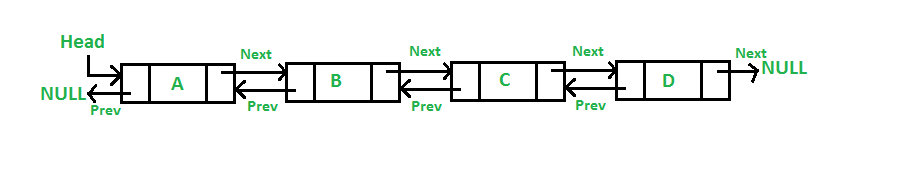
What is a Doubly Linked List?
A doubly linked list is a data structure consisting of nodes where each node contains three parts:
- 1. Data - The value stored in the node
- 2. Previous pointer - A reference to the previous node in the list
- 3. Next pointer - A reference to the next node in the list
Unlike a singly linked list (which only has next pointers), the doubly linked list allows traversal in both directions - forward and backward. This makes operations like reverse iteration, insertion before a node, and deletion more efficient, though at the cost of additional memory for the extra pointer.
METHODS
new
Create a new list. Optionally takes an initial data value.
my $list = Doubly->new();
my $list = Doubly->new($initial_value);
length
Returns the length of the list.
my $len = $list->length;data
Get or set the data at the current position.
my $value = $list->data;
$list->data($new_value);
start
Move to the start of the list. Returns $self for chaining.
$list->start;end
Move to the end of the list. Returns $self for chaining.
$list->end;next
Move to the next node. Returns $self for chaining.
$list->next;prev
Move to the previous node. Returns $self for chaining.
$list->prev;is_start
Returns true if at the start of the list.
if ($list->is_start) { ... }is_end
Returns true if at the end of the list.
if ($list->is_end) { ... }add
Add an item to the end of the list.
$list->add($value);bulk_add
Add multiple items to the end of the list.
$list->bulk_add(1, 2, 3, 4, 5);remove_from_start
Remove and return the first item.
my $value = $list->remove_from_start;remove_from_end
Remove and return the last item.
my $value = $list->remove_from_end;remove
Remove and return the item at the current position. Current position moves to the next node (or previous if at end).
my $value = $list->remove;remove_from_pos
Remove and return the item at the specified position (0-indexed).
my $value = $list->remove_from_pos(2); # Remove third iteminsert_before
Insert an item before the current position. Current position moves to the new node. Returns $self for chaining.
$list->insert_before($value);insert_after
Insert an item after the current position. Current position moves to the new node. Returns $self for chaining.
$list->insert_after($value);insert_at_start
Insert an item at the start of the list. Returns $self for chaining.
$list->insert_at_start($value);insert_at_end
Insert an item at the end of the list. Same as add. Returns $self for chaining.
$list->insert_at_end($value);insert_at_pos
Insert an item at the specified position (0-indexed). Returns $self for chaining.
$list->insert_at_pos(2, $value); # Insert at position 2find
Find a node using a callback. The callback receives each node's data and should return true when the desired node is found. Current position moves to the found node. Returns $self if found, undef otherwise.
my $found = $list->find(sub { $_[0] eq 'target' });
if ($found) {
    print "Found: ", $list->data, "\n";
}
insert (with callback)
Find a position using a callback, then insert data before it. If the callback never returns true, inserts at the end. Returns $self for chaining.
# Insert 5 before the first value > 5
$list->insert(sub { $_[0] > 5 }, 5);
destroy
Explicitly destroy the list and free all memory.
$list->destroy;THREAD SAFETY
This module is designed to be thread-safe. You can:
Create a list in one thread and use it in another
Have multiple threads adding/removing items concurrently
Share the list object across threads
All operations are protected by a mutex.
NESTED LISTS
You can store Doubly lists inside other Doubly lists.
my $outer = Doubly->new();
my $inner = Doubly->new();
$inner->bulk_add(qw/a b c d e f g/);

my $inner2 = Doubly->new();
$inner2->bulk_add(1..1000, $inner);  # inner list is last item

$outer->bulk_add($inner, $inner2);

# Navigate outer list
$outer->start;
is($outer->data->data, 'a');              # inner list, first item
is($outer->data->next->data, 'b');        # navigates inner, returns 'b'

# Navigate to inner2, then to its last item (which is $inner)
is($outer->next->data->data, 1);          # inner2's first item
is($outer->next->data->end->data->start->data, 'a');  # deeply nested!
BENCHMARKS
my $r = timethese(10000, {
	'Doubly::Linked' => sub {
		my $linked = Doubly::Linked->new(123);
		$linked->bulk_add(0..1000);
		$linked = $linked->end;
		$linked->is_end;
		$linked = $linked->start;
		$linked->is_start;
		$linked->add(789);
		$linked->destroy;
	},
	'Doubly::Linked::PP' => sub {
		my $linked = Doubly::Linked::PP->new(123);
		$linked->bulk_add(0..1000);
		$linked = $linked->end;
		$linked->is_end;
		$linked = $linked->start;
		$linked->is_start;
		$linked->add(789);
	},
	'Doubly' => sub {
		my $linked = Doubly->new(123);
		$linked->bulk_add(0..1000);
		$linked = $linked->end;
		$linked->is_end;
		$linked = $linked->start;
		$linked->is_start;
		$linked->add(789);
		$linked->destroy;
	},
	'Doubly::Pointer' => sub {
		my $linked = Doubly::Pointer->new(123);
		$linked->bulk_add(0..1000);
		$linked = $linked->end;
		$linked->is_end;
		$linked = $linked->start;
		$linked->is_start;
		$linked->add(789);
		$linked->destroy;
	},
});

cmpthese $r;
Docker perl:5.38-threaded - Threaded environment (where only Doubly is truly safe):
Benchmark: timing 10000 iterations of Doubly, Doubly::Linked, Doubly::Linked::PP, Doubly::Pointer...
    Doubly: 0.704658 wallclock secs ( 0.70 usr +  0.00 sys =  0.70 CPU) @ 14285.71/s (n=10000)
Doubly::Linked: 4.71918 wallclock secs ( 3.10 usr +  1.61 sys =  4.71 CPU) @ 2123.14/s (n=10000)
Doubly::Linked::PP: 12.1816 wallclock secs (10.76 usr +  1.39 sys = 12.15 CPU) @ 823.05/s (n=10000)
Doubly::Pointer: 0.778561 wallclock secs ( 0.77 usr +  0.00 sys =  0.77 CPU) @ 12987.01/s (n=10000)
		      Rate Doubly::Linked::PP Doubly::Linked Doubly::Pointer Doubly
Doubly::Linked::PP   823/s                 --           -61%            -94%   -94%
Doubly::Linked      2123/s               158%             --            -84%   -85%
Doubly::Pointer    12987/s              1478%           512%              --    -9%
Doubly             14286/s              1636%           573%             10%     --
Docker perl:5.38 - None threaded environment:
Benchmark: timing 10000 iterations of Doubly, Doubly::Linked, Doubly::Linked::PP, Doubly::Pointer...
    Doubly: 0.712633 wallclock secs ( 0.70 usr +  0.01 sys =  0.71 CPU) @ 14084.51/s (n=10000)
Doubly::Linked: 16.0794 wallclock secs ( 4.05 usr +  5.75 sys =  9.80 CPU) @ 1020.41/s (n=10000)
Doubly::Linked::PP: 13.0293 wallclock secs (11.73 usr +  1.27 sys = 13.00 CPU) @ 769.23/s (n=10000)
Doubly::Pointer: 0.775681 wallclock secs ( 0.77 usr +  0.00 sys =  0.77 CPU) @ 12987.01/s (n=10000)
		      Rate Doubly::Linked::PP Doubly::Linked Doubly::Pointer Doubly
Doubly::Linked::PP   769/s                 --           -25%            -94%   -95%
Doubly::Linked      1020/s                33%             --            -92%   -93%
Doubly::Pointer    12987/s              1588%          1173%              --    -8%
Doubly             14085/s              1731%          1280%              8%     --
AUTHOR
LNATION, <email at lnation.org>
LICENSE AND COPYRIGHT
This software is Copyright (c) 2024 by LNATION.
This is free software, licensed under:
The Artistic License 2.0 (GPL Compatible)1 POD Error
The following errors were encountered while parsing the POD:
- Around line 106:
Non-ASCII character seen before =encoding in '┌─────────────────────────────────────────────────┐'. Assuming UTF-8